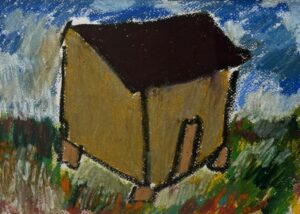
Beverly Buchanan (1940–2015) was born in Fuquay, North Carolina, and raised in South Carolina. Before fully committing to art, Buchanan earned multiple degrees in the sciences and worked as a public health educator in New York City and New Jersey. In 1971, she enrolled at the Art Students’ League, studying under Harlem Renaissance painter Norman Lewis—an experience that marked the beginning of her life as a professional artist.
Initially identifying as an abstract expressionist, Buchanan gained early recognition for her “Wall” paintings, exhibited at the Montclair Art Museum in 1976. After returning to the South in 1977, her practice shifted toward sculpture and site-based work. Between 1979 and 1986, she created a series of public stone installations across the American Southeast, intentionally allowing them to weather and decay. Works such as Ruins and Rituals (1979) and Marsh Ruins (1980), supported by a Guggenheim Fellowship, explored themes of impermanence while honoring the histories of Southern Black communities.
By the mid-1980s, Buchanan turned her attention to Southern vernacular architecture, creating sculptural “shacks” inspired by improvised rural homes in Georgia. Many were accompanied by handwritten or typed “legends,” blending memory and imagination through narrative voices. Her later work drew deeply from nature, folk art, and personal experience, including vibrant oil pastel florals and small assemblages inspired by gardening and local self-taught artists.
Buchanan received numerous honors throughout her career, including fellowships from the John Simon Guggenheim Memorial Foundation and the National Endowment for the Arts. Her work is held in major collections such as the Metropolitan Museum of Art, the Whitney Museum, the Studio Museum in Harlem, and the High Museum of Art. A major posthumous retrospective, Ruins and Rituals, was presented at the Brooklyn Museum in 2016–17.